 Skip to content
Systems Thinking
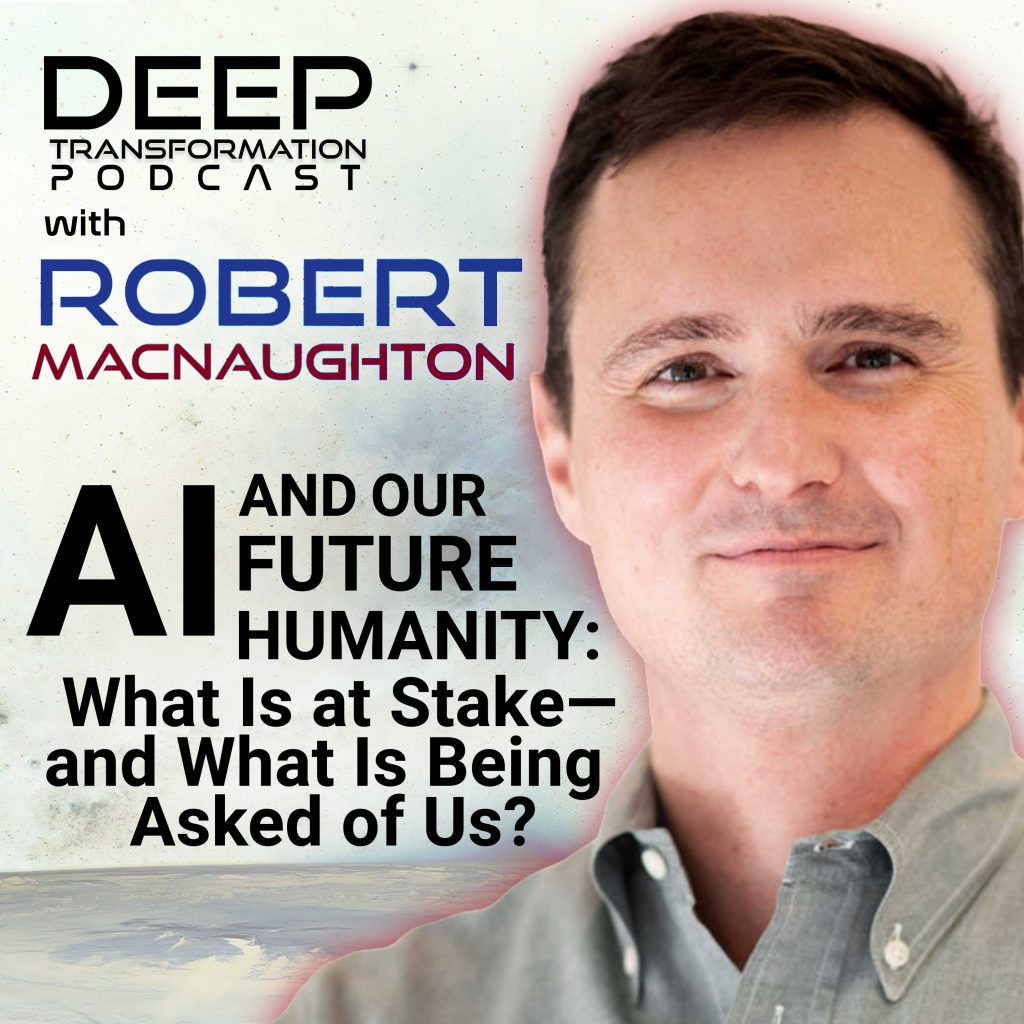
AI and Our Future Humanity: What Is at Stake—and What Is Being Asked of Us?
“If we want to use [AI] for nefarious means, it’ll be very effective, but if we want to use it for awakening, it can be a tool unlike anything humanity has ever had access to.”
Ep. 246 | Strategic advisor Robert MacNaughton is exactly whom we need to help us understand not only the current and emerging risks, challenges, and opportunities AI confronts us with, but also the deeper, bigger, sometimes frightening picture of what is truly at stake here, as we try to make sense of AI and how to chart our course forward through unknown, difficult-to-predict territory. Bright as anything, with a contemplative and integrally informed background, and long experience in leadership and human development, Robert is also an expert on AI. In this very illuminating conversation, Robert shares that his primary concern is not so much the first-order risks (impact on the economy, labor displacement, environmental risks, relational and attentional capture, and more) as the second-order risks: our social and psychological responses to the first-order risks.
We’re starting to see what happens when people get afraid and lose certainty about the future, he relates, and there are people who know how to exploit that fear to gain power. It is up to us to build bridges of knowledge and learn how to work together as never before, and AI can help us with this, Robert asserts. The most important conversation right now, he continues, is asking what capabilities we need to foster to become more epistemically mature and collaborative; what practices will help us with that? Robert suggests that since we need a destination and an orientation to guide our way, we should choose the transcendentals—goodness, truth, and beauty. “Because unless someone can come up with something better, it’s just Elon telling us we need to go to Mars,” he quips. An extraordinary, timely, enlightening, and eye-opening conversation. Recorded May 21, 2026.
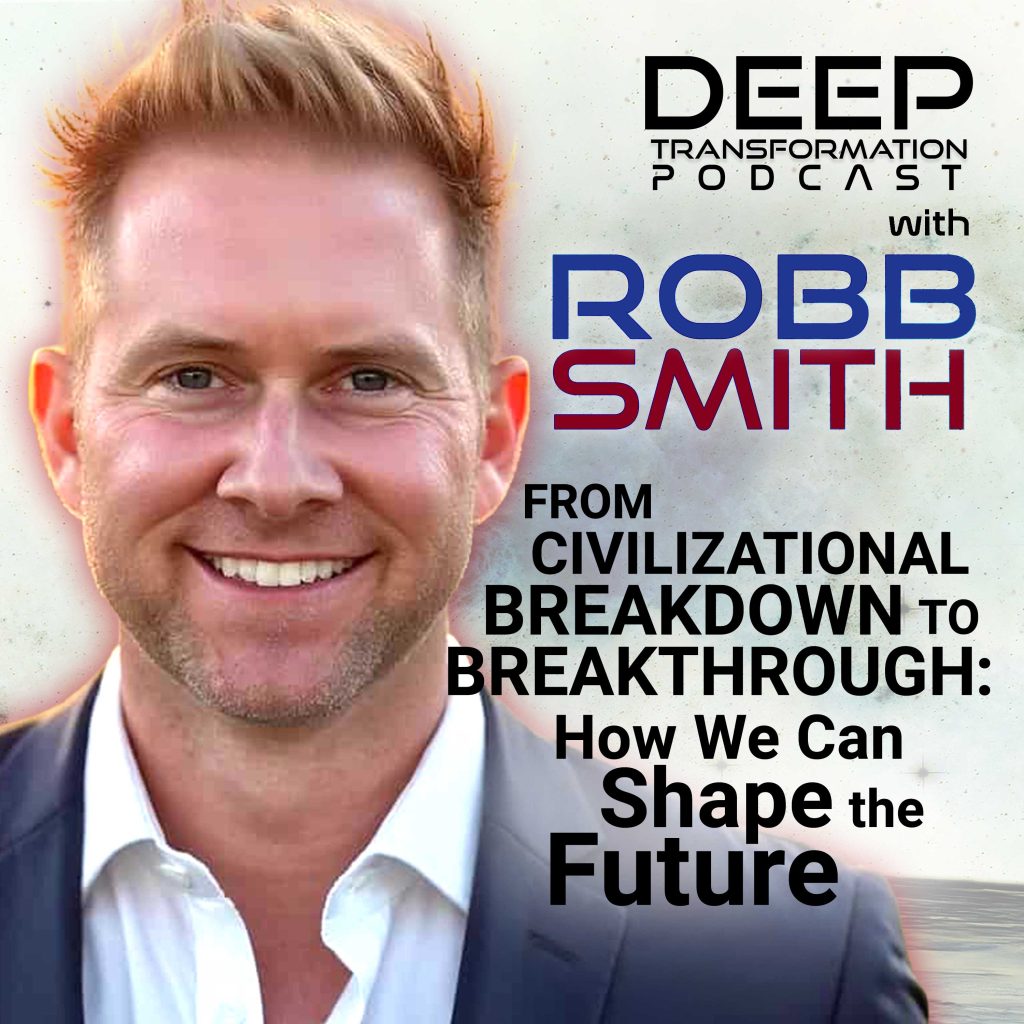
Read MoreFrom Civilizational Breakdown to Breakthrough: How We Can Shape the Future
“The system is going to go into release, because you can only avoid reality for so long. Ultimately, the real always ends up winning.”
Ep. 245 | Robb Smith, social innovator, integral philosopher, and founder of the Institute of Applied Metatheory (IAM), is incredibly illuminating as to the forces and flux at work in the world now and how big picture thinking can help us through this time of transition. Rob’s passion, and the focus of IAM, is working on long-arc, socially impactful ecosystem configurations. “I like the thorny stuff,” he says, “the stuff that hasn’t been figured out yet.” Big-picture perspectives keep getting better, Robb tells us. They have become tractable tools for helping social impact entrepreneurs create systems that benefit society as a whole. Robb calls out to the innovators of the world, those with the “4 C’s” (conscious, complex, curious, compassionate), to use IAM’s sensemaking tools, which he says can help them both look at reality in a more realistic way and better envision new possibilities for what they do in their sphere.
Robb well understands what is currently breaking down, what is potentially being formed, and the interim zone of opportunity. In fact, there is evidence of a whole new worldview emerging—what Robb calls an integrative worldview—a “New Story of Wholeness.” Eros is building in the system, he continues: an explosion of spiritual energy and capital currently blocked that needs to be tapped into and liberated. Robb moves fast, and what he shares is extraordinarily stimulating. As co-host Roger Walsh described it, this conversation is “impassioned, informative, information dense, intellectually sophisticated, inspiring, and probably a few other things as well.” “Everyone should feel hope,” Robb concludes. “We have the power to make the transformation functional and improve the world in a powerful way.” Recorded April 30, 2026.
Read MoreJeremy Lent (Part 2) – Big Picture Systems Thinking: A Key Practice for Understanding, Transforming, and Preserving Civilization

Ep. 142 (Part 2 of 2) | Award-winning author of The Web of Meaning and founder of the Deep Transformation Network, Jeremy Lent, relates how his discovery of systems thinking opened the door to a whole new way of making sense of the world and illumined his in depth exploration of what creates meaning. In looking into what forms concepts like God, soul, humanity, nature, and science, Jeremy came to understand the thinking that has led to the existential crisis we face now, then began to explore what it would take to break out of the worldview that has caused so much destruction on so many levels. Jeremy integrates systems thinking with concepts from evolutionary biology, neuroscience, ecology, and traditional and indigenous wisdom, forming a holistic view of science, where “maybe the distinction between science and spirituality isn’t really valid.”
Jeremy’s heartfelt intention is to act as translator—to make it enjoyable for people to explore difficult concepts like consciousness and evolutionary biology they might otherwise steer away from—as well as be a catalyst for large-scale transformation. His vision of a potential future “ecological civilization” builds on the evolutionary success of life itself—ecosystems living in mutual symbiosis—and includes the idea of “islands of coherence” which would provide a bridge from a disintegrating society to a new and flourishing one. Systems thinking, like indigenous wisdom, recognizes the deep connectedness of all things, a realization, Jeremy points out, that leads to the knowing that nothing is inevitable and the choices we make matter. Jeremy leaves us with a sense of agency and of liberation, as well as a sense of responsibility to work together in the shaping of a life-affirming, sustainable future. Recorded June 20, 2024.
Read MoreJeremy Lent (Part 1) – Big Picture Systems Thinking: A Key Practice for Understanding, Transforming, and Preserving Civilization

Ep. 141 (Part 1 of 2) | Award-winning author of The Web of Meaning and founder of the Deep Transformation Network, Jeremy Lent, relates how his discovery of systems thinking opened the door to a whole new way of making sense of the world and illumined his in depth exploration of what creates meaning. In looking into what forms concepts like God, soul, humanity, nature, and science, Jeremy came to understand the thinking that has led to the existential crisis we face now, then began to explore what it would take to break out of the worldview that has caused so much destruction on so many levels. Jeremy integrates systems thinking with concepts from evolutionary biology, neuroscience, ecology, and traditional and indigenous wisdom, forming a holistic view of science, where “maybe the distinction between science and spirituality isn’t really valid.”
Jeremy’s heartfelt intention is to act as translator—to make it enjoyable for people to explore difficult concepts like consciousness and evolutionary biology they might otherwise steer away from—as well as be a catalyst for large-scale transformation. His vision of a potential future “ecological civilization” builds on the evolutionary success of life itself—ecosystems living in mutual symbiosis—and includes the idea of “islands of coherence” which would provide a bridge from a disintegrating society to a new and flourishing one. Systems thinking, like indigenous wisdom, recognizes the deep connectedness of all things, a realization, Jeremy points out, that leads to the knowing that nothing is inevitable and the choices we make matter. Jeremy leaves us with a sense of agency and of liberation, as well as a sense of responsibility to work together in the shaping of a life-affirming, sustainable future. Recorded June 20, 2024.
Read More