Skip to content
Spiritual Teachings
Midwifing the Diamond Approach: How the Teaching Found and Transformed Hameed Ali & Karen Johnson
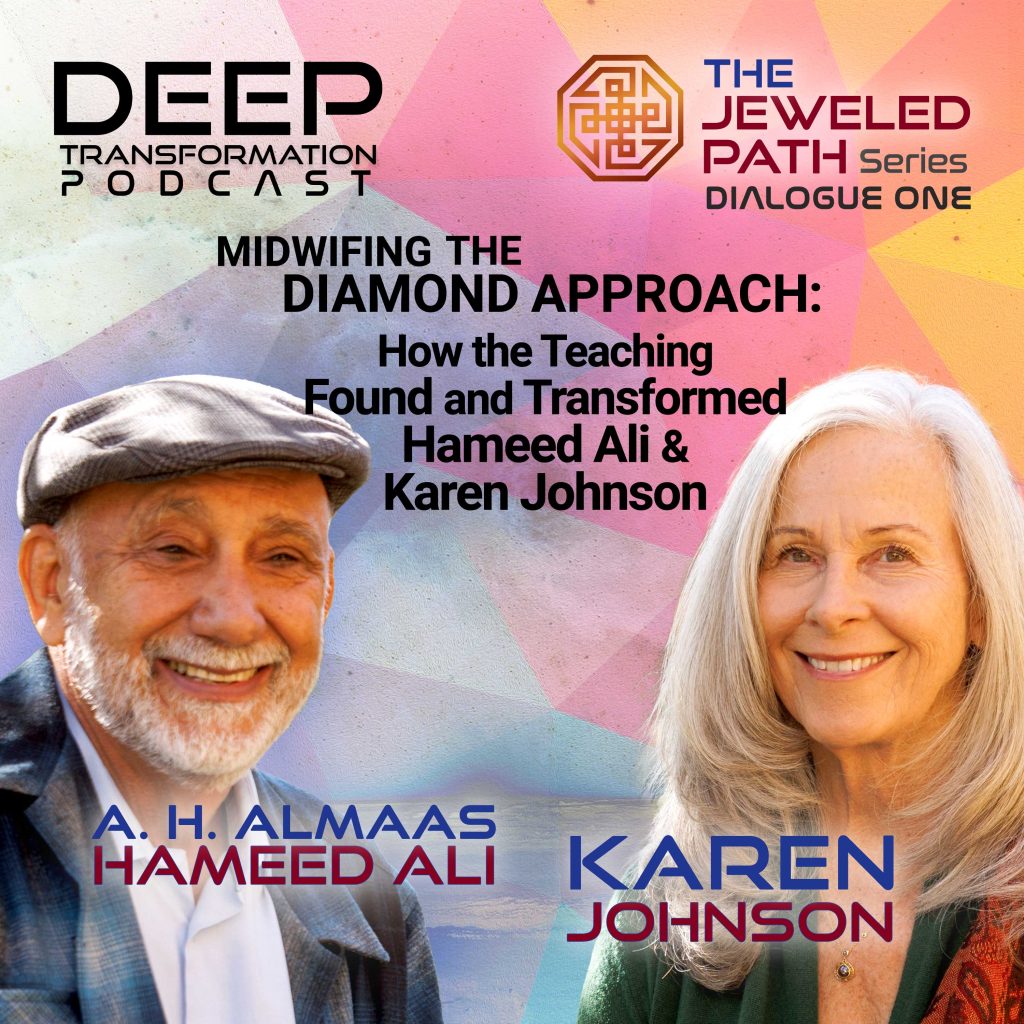
“The interesting thing about presence is, if you talk about it when it’s not there, it’s just an idea—because presence is only now.”
Ep. 242 | What a gift to have Karen Johnson and A. H. Almaas (Hameed Ali) together in conversation to explore their extraordinary journeys of awakening and share the remarkable ways presence found to transform their hearts and minds—all of which culminated in the contemporary spiritual path known as the Diamond Approach. Karen’s book, The Jeweled Path (the basis for this Jeweled Path Series), chronicles Karen and Hameed’s spiritual adventures from the beginning: what happened in their childhoods, how they first met, the emerging realization that what they were experiencing was shaping into a unique path of awakening that others could follow and benefit from also, through the establishment of the Ridhwan School, home of the Diamond Approach.
In this dialogue, Karen tells how incredible spiritual experiences would come to them right in the midst of life—in the grocery store, on the way to work, in a bar… And we hear the resonant story of when Hameed poured a life-changing transmission of presence into her hand. Karen and Hameed’s vivid descriptions of what they experienced—“explosions of consciousness,” “streams of awakening,” “becoming a body of light, fullness, and presence, nowness embodied”—are awakening transmissions in their own right. And the point they drive home—that they were not the founders of the Diamond Approach, rather the teaching found them—has the magical effect of opening us to see reality in a different way. Listening to Karen and Hameed discuss their experiences, insights, and the emergence of the Diamond Path is simply an amazing experience on its own. Recorded August 13, 2026.
Read MoreMany Truths, Many Teachings: Why Spiritual Paths Unveil Reality Differently
“Each path takes a human being deeper, vaster, bigger places… each particular logos can be seen as an expression of the optimizing force of the universe and logos.”
Ep. 240 | Co-host Roger Walsh found the novel concepts that A. H. Almaas presents in The Inner Journey Home’s Appendix G so intriguing, he asked Hameed for one last discussion to complete Deep Transformation’s systematic exploration of Hameed’s magnum opus. In Appendix G (and in this conversation), Hameed says that while there are many valid paths of awakening, different paths do not culminate in the same realization or experience. In other words, the Chinese proverb that says there are many ways to the top of the mountain, but the view is always the same is not accurate. Each spiritual teaching has its own logos, Hameed explains, its own “logic of experience and logic of practice that will naturally unfold the consciousness to open up to the secrets of reality and the depth of it, according to that particular logos.” This makes it possible for all different types of people, also from very different cultures, to “open to the perfection of reality in a way that liberates and makes sense to them.”
The logos of a spiritual teaching is not created by anyone, Hameed continues. This is reality practicing its intelligent, creative, and loving magic by manifesting through an individual or community to provide us with different ways of realizing true nature. When we find the right path, the teaching will “click,” Hameed says, and with time and practice, we may crack the code of the logos of our chosen path and fulfill our spiritual destiny. The conversation weaves in and out of the fascinating implications of Hameed’s teaching, clarifying why Eastern and Western spiritual teachings are so different, and what differentiates the logos of the Diamond Approach. In wrapping up, Roger and John acknowledge that their intensive study of The Inner Journey Home provided them with a transmission—and a transformation. Hameed agrees; by deeply contemplating this book, he says, we open ourselves to the transmission, to the understanding and experiencing of what is presented. Recorded July 16, 2026.
Read MoreExploring God, Soul & Reality: A. H. Almaas’ Mystical Theology
“When we experience the absolute, we see it as the truth of everything, the nature of everything—all are glimmerings of the absolute.”
Ep. 235 | In the 18th dialogue of the A. H. Almaas Wisdom Series, Hameed Ali delves into the fascinating subject of how the physical world is related to the absolute. From a nondual perspective, reality includes the physical world, he explains; the world cannot be reduced to an illusion. Material reality is every bit as compelling as the spiritual perspective, he continues. How we perceive it depends on where we find our stance, what we are immersed in—in the formless or the world of form. Hameed recognizes and honors physical reality, while describing material objects as expressions, or glimmerings, of the ground of being—the physical and the ground of being inseparable, whether pure presence or pure emptiness.
And how does the relationship between creator and creation relate to the individual? Hameed presents his mystical theology: a triadic reality formed by God, the individual, and the physical world, where each maintains its own truth. Because the absolute is inherently not self-aware, it needs an individual to become aware of itself, he explains. We are its “knowing instruments.” Hameed’s mystical theology, establishing the relationship between the human being, the world, and God, or true nature, is both elevating and grounding, enlightening and somehow comforting. The essential puzzle pieces of reality fitted together, creating unity. From atoms and quarks to what happens after death and how all dimensions can possibly exist in exquisite harmony when there is so much disharmony in the world, this conversation is far ranging, stimulating, and punctuated with laughter, as Hameed, Roger, and John continue to explore The Inner Journey Home. Recorded May 14, 2026.
Read MoreBedazzled Mind, Boundless Heart: Living as the Love We Always Longed For
“We can be in the lap of the beloved and still enjoy life—loving everything from that place.”
Ep. 233 | In the last episode of the Path of Love Series with A. H. Almaas, Hameed explores the themes he introduced in the later chapters of his new book, The Inner Beloved. Hameed clarifies the role of mind on the path of heart (the mind is bedazzled and awed; the heart open), and details what happens when we reach the beloved, like “falling in love with everything” and experiencing the absolute as a “coming home” (even though there’s no one there!). We learn that, on the path of love, no matter what we do or don’t do, a heart-driven force beyond the mind is pulling us onward. Once we arrive, we realize the beloved has always been there—which is why our heart has been longing for the beloved all along.
Hameed explains that on the path of love, nonduality becomes intimacy—reality itself is pure intimacy, he says—and in fact, the nonbeingness of the beloved is the ultimate truth of reality. In a state of mystical poverty, we discover that all we are and have ever been has been borrowed from the beloved. The culmination of this Path of Love Series ends very beautifully, the love and intimacy of the beloved pervading Hameed’s words and the images he conjures for us. “The world is simply the luminosity of the beloved,” Hameed says. In listening to him, we share in some of the wonderful sense of coming home he experienced, a little of the radiant luminosity, too, and his own ongoing excitement over the ever unfolding mystery of the divine. Recorded April 9, 2026.
Read MoreAt Our Essence, We Are Love: Becoming Intimate with Everything
“Regardless of what we think and feel, at our essence we are love.”
Ep. 231 (Part 2 of 2) | In Part 2 of Deep Transformation’s third dialogue in the Path of Love Series with A. H. Almaas, Hameed Ali relates what happens on the path of return, after we have experienced dissolving into the radiance of the absolute. In following the path of heart (as opposed to the path of mind), we discover that in addition to pure emptiness, the absolute has (in its beingness aspect) a quality of consciousness that is pure intimacy. “The beloved is intimate with all things in the universe: intimate with people, with the rocks, with the stars… because its nature pervades everything.” Upon returning to the world, we find the universe has become the radiance of the beloved and ordinary life becomes full of love. That said, we may experience a great fear of losing our awakened realization, Hameed adds, which can further stir up old woundings which still need to be faced.
Back in the world, as the embodied beloved, do you feel compassion for other people’s suffering? co-host John Dupuy wonders. The extent of the compassion is almost unimaginable, Hameed answers. There is vast empathy for all the suffering in the world, and especially for the deep suffering underlying it all that is caused by people not knowing their inner truth. It is by giving the beloved the opportunity to appear and know itself as we live our lives that we love and serve the inner beloved, Hameed continues. He explains that awareness is the beloved witnessing its creation, and that the emptiness aspect of the beloved, emphasized in Buddhism and on the path of mind, brings a searing clarity to our experience. A beautiful conversation, in which co-host Roger Walsh remarks that the presence of the inner beloved seems to be increasingly reflected in these dialogues as they unfold. Perhaps you will feel it too. Recorded January 29, 2026.
Read MoreDissolving into Bliss: The Ecstasy of Ego Death
“It is inherent to the human being… the movement to dissolve into bliss, into the beloved.”
The third dialogue in the Path of Love Series with A. H. Almaas opens with co-host Roger Walsh commenting that in reading Hameed’s most recent book, The Inner Beloved, he is struck by how different the Diamond Approach’s path of love is from those in other traditions. Hameed explains that, indeed, his path is different in that it addresses the sequence of events on the path of love systematically, using contemporary psychological language to describe the difficulties and barriers that arise, and further, that he includes not only obstacles that come up in the mind (concepts and beliefs), but emotional pain and woundings, abandonments and betrayals, which is something other traditions don’t often talk about. Why are our hearts not open? Because opening to such painful emotions is scary; our fear blocks us from opening to the vastness of divine love. The secret to moving forward on the path of love, Hameed says, is to love more intensely, more deeply. Love itself is the fuel that gets us through the obstacles to union with the inner beloved.
Hameed speaks of the “death wish” that happens along the path, referring to our desire to dissolve completely into the beloved. “The deep heart loves the prospect of melting away and being nothing, being annihilated, completely absorbed into the beloved,” he explains. The death wish is a common reference in other paths of love, too—the Buddha calls this annihilation of self “emptiness”—and interestingly, Freud recognized it as a universal human characteristic, calling it the nirvana principle. “A deep intuition resides in every human heart,” Hameed continues, “a need for unification with what we love.” This can be small things—chocolate ice cream, our cell phone—which are legitimate objects of love, but in the end, only the inner beloved calls. Once again, Hameed gifts us with an illuminating teaching about the path of love, our desire for nonbeing, the hidden essence of love, and the integration of all we have let go of that happens after we awaken—all coming directly from his own lived experience. Recorded January 29, 2026.
Read MoreChristianity is About Love. Christian Nationalism is Not. Calling Out the Hypocrites with John Fugelsang
“The greatest tragedy to me is when people think that something is religion and don’t realize it’s just fundamentalism.”
In Part 2 of our eloquent, passionate, and humorous, dialogue with comedian John Fugelsang, author of the important and irreverent book, Separation of Church and Hate: A Sane Person’s Guide to Taking Back the Bible from Fundamentalists, Fascists, and Flock-Fleecing Frauds, we come to understand what fundamentalism is, and what it signifies for our culture, our politics, and our future. John outlines five common features that characterize fundamentalism across religious traditions, pointing out that fundamentalist Christians have more in common with fundamentalist Muslims than they do with moderate and liberal Christians. “I go after fundamentalists of all religions,” John says, “because it’s turning people off to faith—ruining Christianity, ruining Islam, ruining Judaism.” This is the tragedy for John and what fuels his passion for calling out the hypocrites who do hateful things in the name of religion.
John also enlightens us as to what Christian nationalism is all about, starting way back: “In the U.S., our history of Christianity is inseparable from our history of white supremacy.” Christian nationalism’s religion is power—a gospel of domination over love. Authoritarian leaders and their followers all worship power, he continues, and fills us in on how Christian nationalism is playing out in Russia now. John’s own message is not hateful; his intention is to make it clear that Jesus always taught love and kindness; to suggest that if the Church wants to survive, it needs to go back to the teachings of Jesus; and to help us come together in a common understanding of fundamental values. “It’s hard to love the bigot in your family,” John says. But we can “…hold to the deepest values, the most love, and do what needs to be done with love. We can’t hate the haters back, but we have to beat them without hating them—that’s the challenge.” Recorded December 18, 2025.
Read MoreTaking Back the Bible from Fundamentalists & Frauds (You Seriously Believe Jesus Said What?) with John Fugelsang

“Jesus is not about condemnation or domination; his whole movement is about transformation.”
Ep. 224 (Part 1 of 2) | John Fugelsang, author of the brilliant, irreverent book, Separation of Church and Hate: A Sane Person’s Guide to Taking Back the Bible from Fundamentalists, Fascists, and Flock-Fleecing Frauds, talks eloquently about the difference between true Christianity as taught by Jesus and the hateful teachings of Christian nationalists and televangelists who are in it for the power and the money. John grew up with a clear notion of what Christianity should look like; his parents lived their faith grounded in peace, love, empathy, and service, dedicating their lives to helping people in need, no matter their color or differences. So John set out to take the Bible back from “small-minded, right-wing, nationalist racists,” because he finds it tragic that vast numbers of people are being alienated from faith altogether, and he wanted to give his readers arguments they could use to face off with right-wing Christians about what the Bible really says. Christians and atheists have told him his book validates all of their beliefs, and he has inspired crowds of atheists to cheer loudly for Jesus.
John is an actor, comedian, and talk show host, and his quick wit and well-informed, well-intentioned intellect make for a fast-paced, enjoyable, and educational foray into subjects such as how right-wing nationalists have made Christianity out to be a religion of condemnation and domination; how they quote Saint Paul, with all of his sex hangups and homophobia, rather than Jesus; and how it’s always been the Christ followers pushing back against authoritarian Christianity—adding that Jesus’ teachings are as threatening to authoritarian power today as they were 2,000 years ago. This is a timely, very important conversation about a subject that involves all of us: reclaiming the foundational values of love, humility, open-mindedness, and service. Recorded December 18, 2025.
Finding Our True Home in the Absolute: Experiencing Intimacy with Everything, with A. H. Almaas

“You don’t have to experience the absolute to know nonduality.”
Ep. 214 (Part 2 of 2) | Part 2 of the 16th dialogue of the A. H. Almaas Wisdom Series takes us on a sweet journey farther into our exploration of the nature of the absolute. Hameed Ali discusses the paradox of the absolute, being both source and cessation of all things, the nonduality of emptiness and beingness, these being two sides of the same coin, and explains why many nondual teachings do not touch upon the absolute. He makes sense of the difficult-to-fathom concept of pure emptiness, explaining that the absolute’s nature is absence—in contrast with presence—and relates that Mystery is the essence of the absolute, the fundamental essence of the nature of reality. “We are never going to know where it’s at, what’s happening, what life is about,” he laughs. Our knowledge is but “small islands in the vast ocean of mystery we live in;” mystery cannot be eliminated.
In the absolute, the soul finds its final resting place, Hameed tells us. The absolute is our true home—the essence of the meaning of home. All humans are searching for their true home, Hameed says, and they search in many places. But here the search is over. Reflections of the absolute bring us closer to love, like when we are in love, Hameed continues. Being in love with an outer beloved brings us closer to the inner beloved and we see deeper. “The absolute is total intimacy, Hameed finishes. “In the absolute we are intimate with everything.” How do we express this in the world, in our ordinary lives? “It becomes very simple,” Hameed says. “The absolute is the essence of simplicity—so simple, even though there is a profundity…” Recorded October 9, 2025.
Into the Absolute: At One with the Radiant Source of All, with A. H. Almaas (Part 1)
“The absolute itself is majesty, and the universe that emerges is beauty.”
Ep. 213 (Part 1 of 2) | The 16th dialogue of the A. H. Almaas Wisdom Series is about the absolute, the source dimension of all manifestation, deeper than any other dimension, the vastness beyond vastness. In Part 1, Hameed gives a wonderful description of the majesty and the blackness of the absolute, and tells the story of when he first experienced being one with the absolute himself. When Roger Walsh asks him, what are the doorways to the absolute, Hameed talks about mystical poverty and also the way of the heart. “When the true beloved shines through the heart, it’s an amazing ecstasy… a mindblowing kind of beauty,” he says. He discusses the fear people often feel as they approach cessation of all perception, and the need for the basic trust we were born with (which often gets clobbered as we grow up) to proceed. What changes after an experience of the absolute? John Dupuy asks. If one abides in this realization, it cleanses the soul of all impurities, and our action embodies the virtues, Hameed answers.
In Part 2, which will be released December 25th, Hameed delves into the paradox of the absolute (the absolute is the elimination, the annihilation, the cessation of all things—and the source of all things), the nonduality of emptiness and awareness, and explains that mystery is the essence of the absolute: the absolute IS mystery, he says. There is laughter all around when Hameed says you can never completely “get” it, because there’s nothing there to get! Your mind disappears as you’re trying to get it. Towards the end, the conversation relaxes so deeply into the subject of the absolute, you can just about feel its presence. We become intimate with everything in the absolute, Hameed says. It is the soul’s final resting place, our true home, where the search ends. Recorded October 9, 2025.
Read More