Skip to content
Podcast Episodes
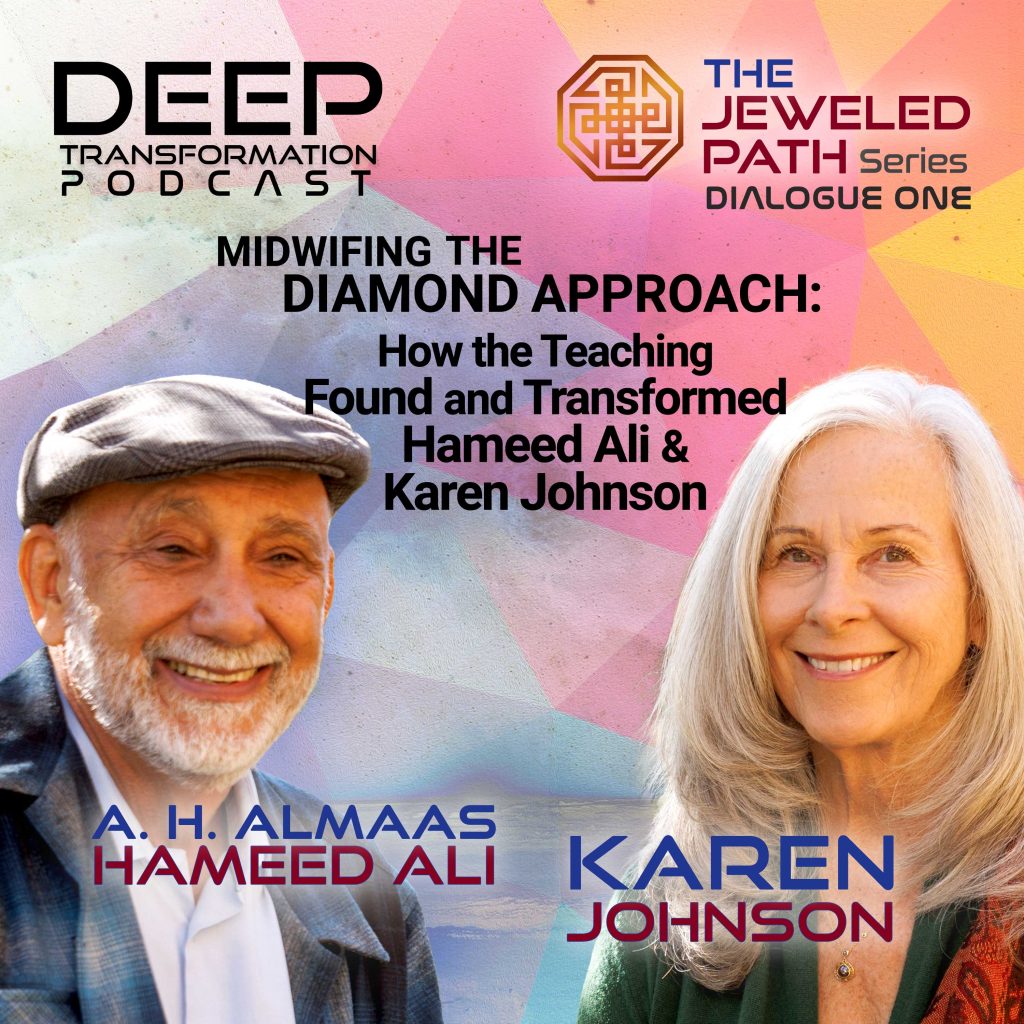
Midwifing the Diamond Approach: How the Teaching Found and Transformed Hameed Ali & Karen Johnson
“The interesting thing about presence is, if you talk about it when it’s not there, it’s just an idea—because presence is only now.”
Ep. 242 | What a gift to have Karen Johnson and A. H. Almaas (Hameed Ali) together in conversation to explore their extraordinary journeys of awakening and share the remarkable ways presence found to transform their hearts and minds—all of which culminated in the contemporary spiritual path known as the Diamond Approach. Karen’s book, The Jeweled Path (the basis for this Jeweled Path Series), chronicles Karen and Hameed’s spiritual adventures from the beginning: what happened in their childhoods, how they first met, the emerging realization that what they were experiencing was shaping into a unique path of awakening that others could follow and benefit from also, through the establishment of the Ridhwan School, home of the Diamond Approach.
In this dialogue, Karen tells how incredible spiritual experiences would come to them right in the midst of life—in the grocery store, on the way to work, in a bar… And we hear the resonant story of when Hameed poured a life-changing transmission of presence into her hand. Karen and Hameed’s vivid descriptions of what they experienced—“explosions of consciousness,” “streams of awakening,” “becoming a body of light, fullness, and presence, nowness embodied”—are awakening transmissions in their own right. And the point they drive home—that they were not the founders of the Diamond Approach, rather the teaching found them—has the magical effect of opening us to see reality in a different way. Listening to Karen and Hameed discuss their experiences, insights, and the emergence of the Diamond Path is simply an amazing experience on its own. Recorded August 13, 2026.
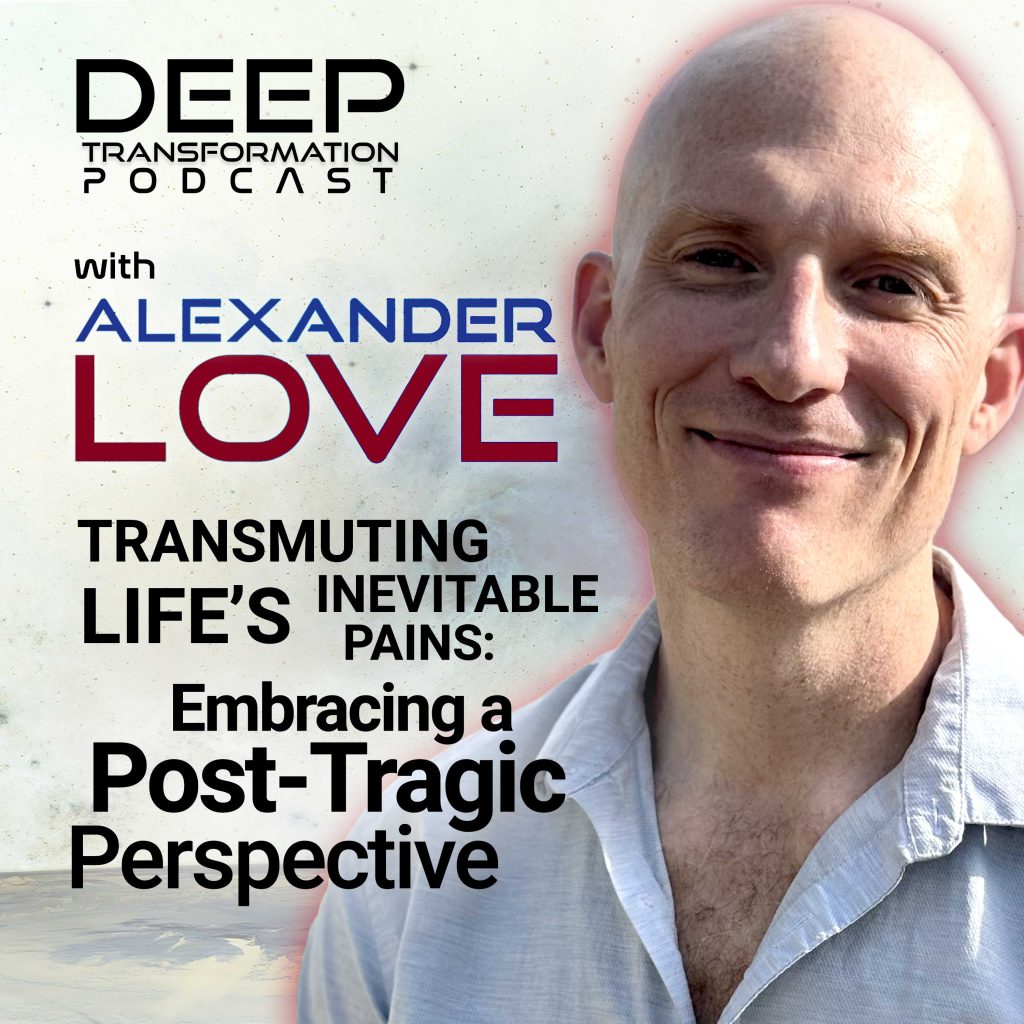
Transmuting Life’s Tragedies: Embracing a Post-Tragic Perspective
“It’s not forgive and forget… It’s remember deeply. Become so intimate with what happened, feel every aspect of it, and let it be transformed by love.”
A deeply engaging conversation in which Alexander Love, adult development expert and coach, and author of the soon-to-be-published trilogy Evolutionary Gestures, introduces us to the post-tragic perspective, with all of its potential to nourish, ground, and open us to a world of possibilities. Alexander explains that post-tragic is not a developmental stage per se, but a dimension available to anyone willing to do the work. It’s part of a triad—pre-tragic innocence, tragic disillusionment, and post-tragic possibilities—encountered in every wisdom tradition, the hero’s journey, and every good story. Post-tragic is not about leaving the tragedy (trauma, pain, loss) behind, but about turning toward it and dropping into a dimension of being that can interface with it in a new way, from a place that isn’t divided or broken. It’s also about asking, what happens next, after the tragedy? How does the story proceed?
Shattering our certainty, a tragic event in our lives makes our world more diaphanous, Alexander continues, opening the way for us to lean further into the mystery. Here we encounter the vastness of possibility, the mystery being the first imagined wholeness, the seed of all potentiality, and we begin to see the sacred and the beauty in everything. Though the healing notion of facing our trauma and working through it is not new, Alexander’s pre-tragic, tragic, and post-tragic framework (deeply informed by his own experience) is compelling. With it, he has painted in the entire landscape around the core tragedy or trauma, giving us the full picture, the before and after, and connected us with a dimension of compassion and forgiveness that is liberating and full of promise. A wise, gentle, intense, warm, humble conversation. Recorded April 23, 2026.
Many Truths, Many Teachings: Why Spiritual Paths Unveil Reality Differently
“Each path takes a human being deeper, vaster, bigger places… each particular logos can be seen as an expression of the optimizing force of the universe and logos.”
Ep. 240 | Co-host Roger Walsh found the novel concepts that A. H. Almaas presents in The Inner Journey Home’s Appendix G so intriguing, he asked Hameed for one last discussion to complete Deep Transformation’s systematic exploration of Hameed’s magnum opus. In Appendix G (and in this conversation), Hameed says that while there are many valid paths of awakening, different paths do not culminate in the same realization or experience. In other words, the Chinese proverb that says there are many ways to the top of the mountain, but the view is always the same is not accurate. Each spiritual teaching has its own logos, Hameed explains, its own “logic of experience and logic of practice that will naturally unfold the consciousness to open up to the secrets of reality and the depth of it, according to that particular logos.” This makes it possible for all different types of people, also from very different cultures, to “open to the perfection of reality in a way that liberates and makes sense to them.”
The logos of a spiritual teaching is not created by anyone, Hameed continues. This is reality practicing its intelligent, creative, and loving magic by manifesting through an individual or community to provide us with different ways of realizing true nature. When we find the right path, the teaching will “click,” Hameed says, and with time and practice, we may crack the code of the logos of our chosen path and fulfill our spiritual destiny. The conversation weaves in and out of the fascinating implications of Hameed’s teaching, clarifying why Eastern and Western spiritual teachings are so different, and what differentiates the logos of the Diamond Approach. In wrapping up, Roger and John acknowledge that their intensive study of The Inner Journey Home provided them with a transmission—and a transformation. Hameed agrees; by deeply contemplating this book, he says, we open ourselves to the transmission, to the understanding and experiencing of what is presented. Recorded July 16, 2026.
From Lifespan to Joyspan: Embracing a Growth Mindset for Aging
“When we step into our power, we can revolutionize longevity.”
Renowned gerontologist and author Dr. Kerry Burnight is passionate about changing the way we think about aging. Growing older isn’t a bad thing, she emphasizes, let’s look at what gets better as we get older! Early in Dr. Kerry’s career, she marveled at how elderly people with the same degree of physical health could be absolutely miserable or happily engaged with life, and she dug into finding out why. Her research revealed four pillars of aging that together make all the difference in the quality of our well-being. Kerry urges us to adopt these practices as soon as we can, because just like with cardiovascular training, the earlier we start, the more benefit we accrue. In fact, the evidence is clear: research shows that people who have a “decline mindset” about aging die an average of seven years earlier than their counterparts with a “growth mindset.” It seems our beliefs about aging can easily become self-fulfilling prophecies.
Finding joy in the second half of life involves not only cultivating connection and growth among other things, but also, very importantly, countering our own internalized ageism. Dr. Kerry gives some telling examples of common derogatory thoughts we have about ourselves as we age, and shows us how we can turn this around and step into our power as older people. In a moving testament to the special beauty and authenticity of the elderly, Kerry expresses gratitude for her opportunities as a gerontologist to be infused with the presence of her patients, in all their humility and greater appreciation of friendships, nature, music, art—of life itself. A poignant, lovely, illuminating, and inspiring conversation with someone who lives her talk and is making a meaningful difference in a culture that has lost its way in its approach to aging and caring for elders. Recorded September 18, 2025.
Meeting the Pain of the World: A Path to Collective Healing
“Unconscious information is destiny. Conscious information has a choice, has a future.”
In this brilliantly articulated and illuminating conversation, renowned international facilitator Thomas Hübl shares his deep understanding of the dynamics of collective trauma as well as practical wisdom about how we can heal the large, often inherited, wounds we carry. Thomas conveys the magnitude of problems created by shoving our collective wounds out of sight and mind, perhaps the worst consequence of which is when we do this, we are destined to repeat the same horrors over again. What we need, Thomas explains, is to develop an architecture that would provide a healing space to deal with our wounds (racism, genocide, and immigration, to name a few). Meeting our collective pain in this way would allow us to mature to a level of forgiveness where we could collaborate globally on urgent issues like AI and climate change. Without this healing, Thomas says, the energy that can forgive remains frozen in the wound.
The dialogue becomes profoundly hopeful as Thomas describes someone who has met their pain and healed themselves of individual and collective trauma. Listening is like receiving a transmission—for a moment we feel ourselves to be this person: integrated, authentic, vulnerable, fully attuned to our reality, at peace with both the beauty and the difficulties, free of false hopes and unrealistic dreams. If we could embrace the power of collective healing that Thomas has witnessed again and again in his work, and “melt the permafrost of our collective trauma,” we could step out of the never-ending cycle of violence, cruelty, and misunderstanding that will otherwise continue to haunt us. This conversation goes right to the heart of things: if we recognize our interrelatedness and find a way to practice interdependence, we can grow beyond our individual and collective pain into a tremendously more hopeful future. Recorded October 30, 2025.